Franck Euvrard · market entry in Asia
Five questions about evidence, not strategy. Each one carries the answer your own record implies, so you correct rather than faces a blank page. A correction is worth more than a blank.
0 of 5 answered
Your last three market entries: which company, which country, and what was already signed when you arrived?
The trigger is what we hunt for later. Companies and dates, not sectors.
The answer your record implies
In each one, what existed when you left that did not exist when you arrived?
This is the only thing that turns a role into a case. One sentence each is enough.
The answer your record implies
Which mandates did you turn down, and why?
A refusal qualifies a buyer faster than a claim. It is also the part nobody else on the bench publishes.
The answer your record implies
Who signed you, by seat, not by name?
It decides who the platform approaches: the chair that owns a new-market P&L behaves differently from a group HR director.
The answer your record implies
What goes wrong in the first ninety days, every time?
The failure mode you can describe is the one piece of content only you can write.
The answer your record implies
What is published about you
their partners page · your own AboutFranck is an international executive with 30+ years of leadership in automotive, engineering services, and IT across Europe and Asia. He has held senior roles in program management, manufacturing, and digital transformation for OEMs, Tier-1 suppliers, and tech firms.
The sentence the whole offer turns on
your words, not oursYou have already written your own position, four paragraphs down your About.
“I also led Faurecia in India and KPIT in France: a French group operating in India, then an Indian group operating in France. Two sides of the headquarters conversation.”
Not one of the other 24 partners can say that, and a buyer can check it in about a minute. It names a situation rather than a seniority, which is what question 5 is trying to get you to expand.
So the work is not writing. Behind those words sit 23,573 followers who, as far as a logged-out reader can tell, never receive anything. Your gap is frequency.
Anything you would hand a new joiner on your first day.
All optional, ranked by what they actually change. The first two are worth ten of the others, and neither is a brand document.
Gives the trigger, the buyer and the outcome in your own words. This is the input that unblocks the four business cases.
Turns five scored components into six and gives you a real authority score instead of a profile score.
Tells us who you actually sell to, which usually contradicts the stated ICP.
You run the same job in reverse today; if that is documented it is proof rather than a claim.
Useful for dates and employers. It will not contain an outcome, so it cannot unblock the cases.
Market entry. Not leadership transitions, and the record is what decides it.
You write that you help with market entry, business transformation and leadership transitions. Three offers in one sentence is none, so one had to win. This is the count that chose it.
Market entry and cross-border
7 checkable itemsLeadership transitions
0 checkable itemsNothing is named. Not one interim mandate, not one seat held temporarily, not one succession. The word appears in your own sentence and nowhere in your history.
“Cross-Border Expansion” is one of your four domains on the firm's own partners page. There is no transitions domain.
Why this beats the easier signal
A C-level departure is marginally easier to screen than a market entry. We are still choosing market entry.
Seven checkable items support market entry and cross-border. Zero support leadership transitions: not one interim mandate, seat held temporarily or succession is named anywhere in your record. On findability alone a C-level departure screens marginally better than a market entry, and that does not settle it. A signal you can find but cannot credibly answer buys a fast rejection. A company whose country head just walked out will ask which seats you have held, and you have no answer. A company standing up an entity in Vietnam will ask whether you have done it there, and you ran product development at VinFast. The buyer is better too: a departure is an emergency with a search firm already circling, an entity opening is a budgeted programme whose decision-maker is the person who signed it.
Three things do not hold up yet
This is the part worth paying for. Nothing publishes in your voice until these are answered.
Seven checkable items say where you have been and what you ran. Not one says what changed because you were there. Until one exists, every piece of your material carries a company and a country and nothing else.
Unblocked by: Answer question 2 with one sentence per mandate.
23,573 followers and, to a logged-out reader, no authored posts. The asset is built and switched off, which is why the profile scores 1/10 on being published.
Unblocked by: Approve the four briefs, and paste what you have posted before.
Business transformation and leadership transitions appear in your own sentence and nowhere in your record. Market entry has seven items behind it, which is why the offer is market entry alone.
Unblocked by: Confirm the positioning, or produce evidence for another line.
The offer, in one sentence
For a company standing up its first operation in an Asian market, or absorbing one it has just bought there, the entity opens, hires and starts deciding locally instead of waiting on a headquarters eight time zones away, by way of an executive who has already built and run that function in that country leads it on the ground from week one, and hands over to the permanent team.
You are not entering a market. You are starting a company in a country you do not know yet.
Who it is not for. Anyone wanting a market study, a partner search or a deck; a market outside the four you have run; or a mandate with no operational authority.
And who it is sold to
Six attributes, and five of them are a filter in the signals rail rather than a description. An ICP the platform cannot act on is a slogan: the one line we cannot filter yet says so instead of pretending.
A strong profile. Nobody hears it.
The same six questions this platform asks of every surface, so your profile can be compared line by line with the firm's website (3/10) and its LinkedIn page (4/10). Read from the About you pasted on 2026-09-23.
One point above the page, two above the website
A strong operator describing three jobs at once, to an audience that never hears from you. The evidence is unusually good: seven checkable items, four countries, and one sentence nobody else on the bench can say. All of it currently supports a market-entry offer that the profile does not actually make.
The number that decides the work
Published to the audience: 1 / 10.
Every other sub-score on this profile is average or better, and one of them is a 9 that nobody else on the bench can claim. The asset is built and it is switched off. Fixing the words moves this profile by a point or two; switching it on is the whole difference, and it costs nothing but a decision to publish.
What produced each score
read from your About · 2026-09-23Your posting history. We hold your About and your 23,573 followers because you pasted them; nobody has pasted what you post or when. An authority score is a behaviour score, so without that input there is no number. A follower count on its own would rate a silent profile as a loud one.
Your new profile. The page on the left, everything to reproduce it on the right.
Nothing publishes from here: you paste it yourself. So the left is exactly what a visitor will see, and the right hands over every asset that makes it, one at a time.

I run your first operation in Asia until your team can · India, Japan, China, Vietnam
Greater Paris Metropolitan Region · 23,573 followers
About
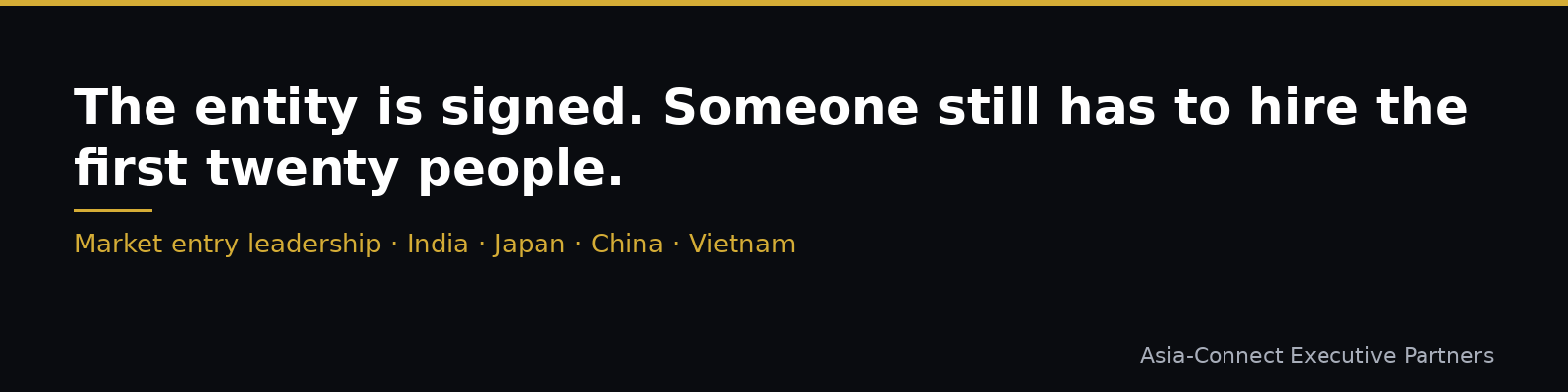
You have signed the entity. Now somebody has to hire the first twenty people, in a country where you do not yet know which twenty.
I build and run your first operation in an Asian market, on the ground, until your permanent team can. Not a study, not a partner search: the operating job, with the authority to do it.
I also led Faurecia in India and KPIT in France: a French group operating in India, then an Indian group operating in France. Two sides of the headquarters conversation.
I have led global engineering and R&D at Tata Technologies in India, product development at VinFast in Vietnam, and vehicle systems integration at ICONIQ Motors in China. Based in Japan with Faurecia, my scope also covered South-Korea and Thailand. As CEO of Dicatrie I take Asian companies into Europe, and I serve as a Conseiller du Commerce extérieur de la France.
Not a market study, not a partner search, not a deck. Not a market outside the four I have run. Not a mandate without operational authority.
Tell me which country and what you have signed. I will tell you within a day what the first ninety days actually contain.
Experience
Since Mar 2025 · Singapore and Paris
I take the operating job when a company is standing up its first entity in an Asian market, or absorbing one it has just bought there.
India, Japan, China and Vietnam: the four markets I have run in myself, not covered from a regional office.
Asia-Connect is a bench of 25 partners across 13 markets. Where a mandate is outside my four, I say so and route it to the partner who has run it.
Featured

The page as a visitor sees it. Every element of it is on the right.
The six changes, and why each one
Headline
What it says now
I run your first operation in Asia until your team can · India, Japan, China, Vietnam
Why
A role title says what you ARE. This says what you DO and names the four countries you can prove, which is the whole asset.
First line of the About
What it says now
You have signed the entity. Now somebody has to hire the first twenty people, in a country where you do not yet know which twenty.
Why
A question as an opening makes the reader do the work. This states their week back to them.
The offer sentence
What it says now
I build and run your first operation in an Asian market, on the ground, until your permanent team can.
Why
Three offers in one sentence is none. Market entry is the one with seven checkable proofs behind it; the other two have nothing named.
The sentence that proves it
What it says now
(moved to paragraph two, unchanged)
Why
"A French group operating in India, then an Indian group operating in France" is the strongest sentence you own, and it is a market-entry sentence. It was four paragraphs down. Not rewritten: moved.
Who it is NOT for
What it says now
Not a market study, not a partner search, not a deck. Not a market outside the four I have run. Not a mandate without operational authority.
Why
Scored 4/10 on qualification. A refusal is what makes the rest believable, and it is the same refusal the landing page makes.
Ending
What it says now
"Tell me which country and what you have signed. I will tell you within a day what the first ninety days actually contain."
Why
Scored 3/10 on next step. An action, a named turnaround, and it asks for the two facts that qualify the reader.
Profile picture

Banner
Download
1584 × 396. One image, because LinkedIn shows one. It states the reader’s situation rather than repeating the headline: the headline is the only place that speaks in the first person, so the banner and the headline do two different jobs instead of the same one twice.
Headline
I run your first operation in Asia until your team can · India, Japan, China, Vietnam
About
You have signed the entity. Now somebody has to hire the first twenty people, in a country where you do not yet know which twenty.
I build and run your first operation in an Asian market, on the ground, until your permanent team can. Not a study, not a partner search: the operating job, with the authority to do it.
I also led Faurecia in India and KPIT in France: a French group operating in India, then an Indian group operating in France. Two sides of the headquarters conversation.
I have led global engineering and R&D at Tata Technologies in India, product development at VinFast in Vietnam, and vehicle systems integration at ICONIQ Motors in China. Based in Japan with Faurecia, my scope also covered South-Korea and Thailand. As CEO of Dicatrie I take Asian companies into Europe, and I serve as a Conseiller du Commerce extérieur de la France.
Not a market study, not a partner search, not a deck. Not a market outside the four I have run. Not a mandate without operational authority.
Tell me which country and what you have signed. I will tell you within a day what the first ninety days actually contain.
Every company named is already on your public record. No duration, no percentage, no client outcome, because the firm publishes none.
Current position
Partner · Asia-Connect Executive Partners
Since Mar 2025 · Singapore and Paris
I take the operating job when a company is standing up its first entity in an Asian market, or absorbing one it has just bought there.
India, Japan, China and Vietnam: the four markets I have run in myself, not covered from a regional office.
Asia-Connect is a bench of 25 partners across 13 markets. Where a mandate is outside my four, I say so and route it to the partner who has run it.
Your current role says “Partner” and stops. This is the field a visitor reads straight after the About, so it says what the role delivers, in the same words as the offer.
Featured · 4
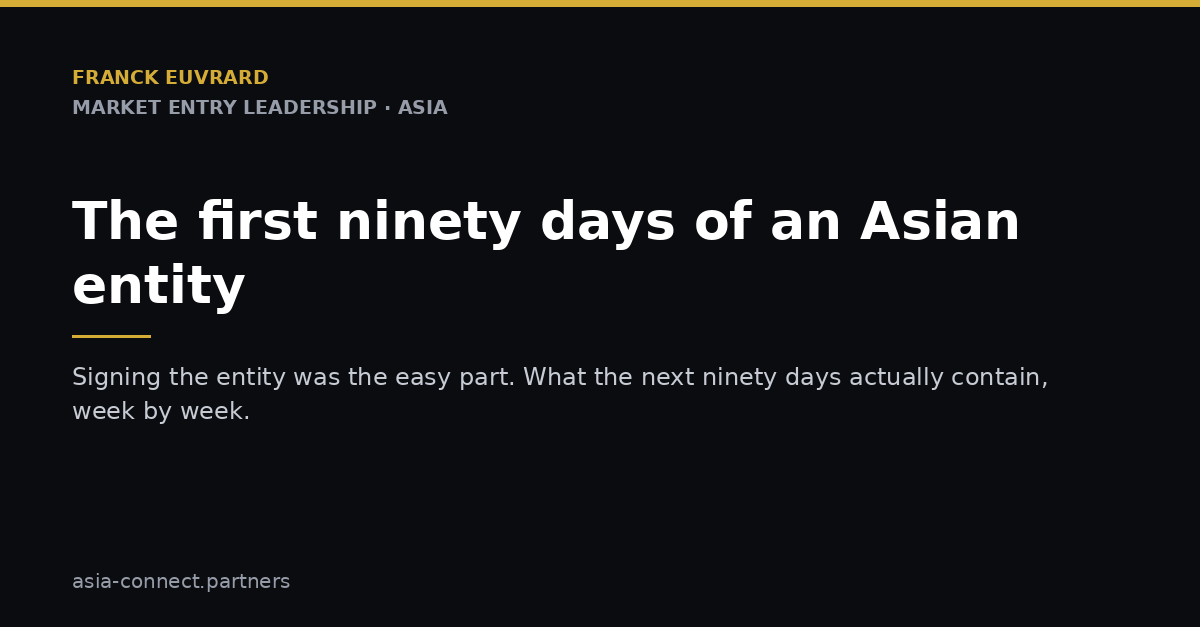
The first ninety days of an Asian entity
Signing the entity was the easy part. What the next ninety days actually contain, week by week.
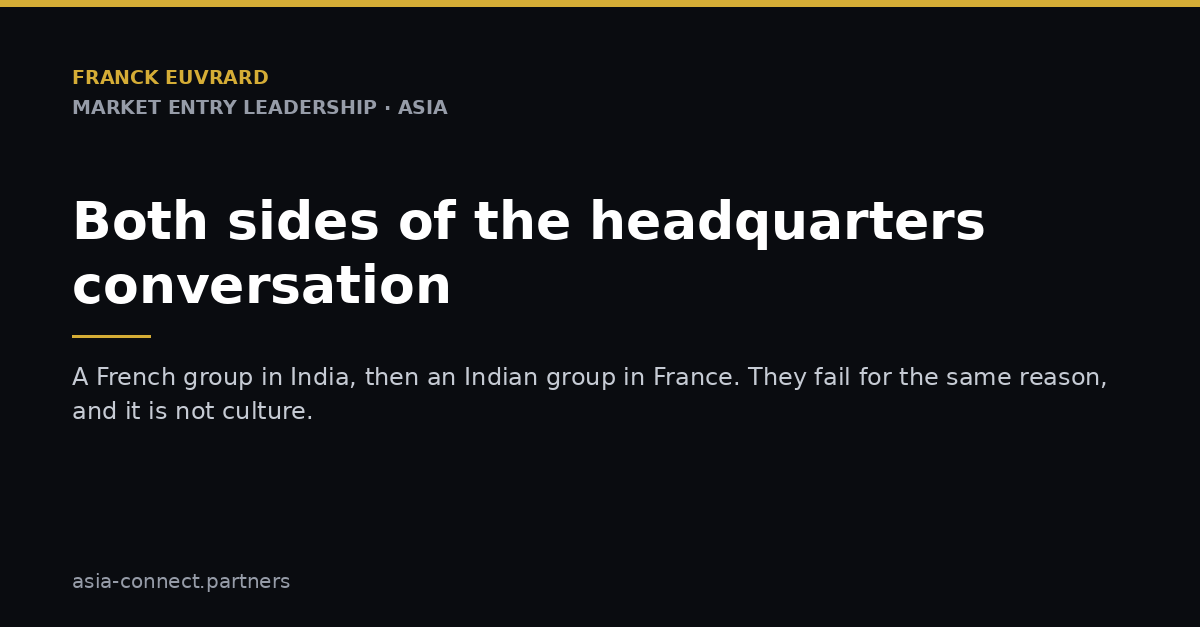
Signing the entity was the easy part. What the next ninety days actually contain, week by week.Both sides of the headquarters conversation
A French group in India, then an Indian group in France. They fail for the same reason, and it is not culture.
A French group in India, then an Indian group in France. They fail for the same reason, and it is not culture.What a market study will not tell you
You can buy a hundred pages about the market. None of it tells you which twenty people to hire first.
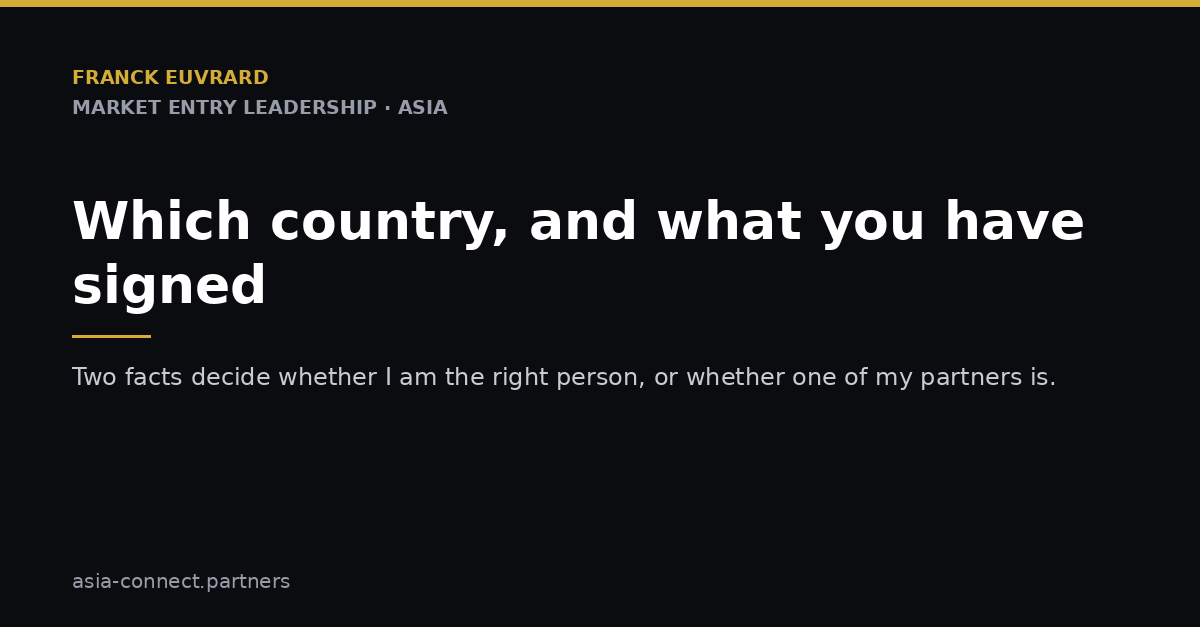
You can buy a hundred pages about the market. None of it tells you which twenty people to hire first.Which country, and what you have signed
Two facts decide whether I am the right person, or whether one of my partners is.
Two facts decide whether I am the right person, or whether one of my partners is.Four cases from your own record. Not one invented result.
Four cases, and not one invented result. The situation and the role in each are already public on the firm’s own pages, so a buyer can check them. The challenge is the failure mode the job is known for, which is what makes it a story rather than a line on a CV. The outcome is the one part we will not write for you: each case ends with the exact question you have to answer, and one sentence from you turns it into proof.
A car company that did not exist yet, hiring the people who would build it Vietnam
The situation, already public
You led product development at VinFast in Vietnam, a manufacturer standing up a capability the country had never had.
The challenge that job is known for
Nobody local has done it before, because nobody local has done it before. The engineering process has to be imported and taught at the same time as it is being used on a real programme with a real launch date, and every week spent training is a week the schedule does not get back.
Why it matters to a buyer
This is the market-entry problem in its hardest form: not opening an office, but building an operating capability from nothing, on a deadline.
The outcome, open
Which programme, and what existed at the end that did not exist when you arrived?
One sentence from Franck turns this into a case study a buyer can act on. We will not write it for you.
An Indian group selling engineering to European customers who did not trust it yet India
The situation, already public
You led global engineering and R&D at Tata Technologies, an Indian company whose buyers sit in European headquarters.
The challenge that job is known for
The work is good and the buyer assumes it is not. Every review becomes an audit, every delay confirms a prejudice nobody says out loud, and the engineering leadership spends its time defending the model instead of running it.
Why it matters to a buyer
You later ran the mirror image of this at KPIT in France, which is why your one sentence about both sides of the headquarters conversation is not a slogan.
The outcome, open
Which account or programme, and what changed in how the European side worked with you?
One sentence from Franck turns this into a case study a buyer can act on. We will not write it for you.
The same failure, seen from both ends India, then France
The situation, already public
You ran a French group operating in India, then an Indian group operating in France.
The challenge that job is known for
Headquarters believes the local team is slow. The local team believes headquarters does not understand the market. Both are describing the same missing thing: nobody with authority sits in the middle, so every decision travels twice and arrives late.
Why it matters to a buyer
Not one of the other 24 partners can say they have sat on both sides of it. This is the case that sells the others.
The outcome, open
One decision that used to take weeks and stopped doing so. What changed?
One sentence from Franck turns this into a case study a buyer can act on. We will not write it for you.
Integration, where every supplier is local and every standard is not China
The situation, already public
You ran vehicle systems integration at ICONIQ Motors in China.
The challenge that job is known for
Integration is where a market entry actually fails. The parts arrive, each one correct, and the whole does not work, because the interfaces were agreed in two languages against two sets of assumptions. It surfaces late, which is the expensive time to find it.
Why it matters to a buyer
A buyer entering China is usually told about regulation and rarely about this. You have lived it.
The outcome, open
What did you change about how interfaces were agreed?
One sentence from Franck turns this into a case study a buyer can act on. We will not write it for you.
Why the outcomes are blank on purpose
A number nobody can check is worth less than a question asked in public.
The firm publishes 0 case studies and 0 named clients. Writing “cut time to market by 30 per cent” here would take ninety seconds and would be the one thing that destroys you in a room with a buyer who checks. Each case instead ends on the exact question you have to answer, and the day you answer, that case becomes proof the whole bench can point at.
A page for the buyer who clicked your profile. One offer, your proof, your refusals.
A profile can make somebody curious; it cannot qualify them. This page does, in the firm's own palette on black, and everything on it is either a company you have run or a country you have run it in. Not one outcome, percentage or client name, because the firm publishes none.
Open the page in its own tab →
Why it is not the firm's page with your name on it
- The firm's page sells a bench: 25 people, one of whom will fit. This page sells one man who has already done the exact job in the exact country.
- Its proof is your record, not the firm's size. Six entries, each a company and a country a buyer can check in a minute.
- It shares the shell and the palette with the firm's page, from one generator. A colour fixed there is fixed here, by construction.
The four refusals, in public
A market study. A partner search. A market you have not run. A mandate with no authority.
Refusals are the cheapest credibility on a page that has no case studies to show. They also disqualify the consultancy pitch in the reader's mind before you have to argue against it.
2 signals, not 8. You are positioned on market entry, so you are screened on market entry.
The firm screens on 8 triggers across three service lines. 2 of them are a company arriving in a market, and those are the only ones Franck is put in front of. The other 6 are not deleted: they are real signals for Asia-Connect and the wrong ones for this partner, so they are routed to the bench.
What we are not going to pretend
A market entry is a programme with paperwork, and paperwork is the part we can find.
An entity registration, a JV announcement or a closed acquisition all leave a public trace, which is why both of your triggers are graded high. That is the argument for this positioning over leadership transitions, where the trace is a person quietly disappearing from a page. Even so, no number of signals a month is promised here, because that number would be invented.
Your references, and who else has the same problem
6 companies you have actually run inside, and 15 same-sector peers that are not yours. The references are read from your record; the competitors are proposed here for you to confirm. When setup finishes, these are the accounts the platform starts screening for the two triggers above.
Automotive tier-1
Vehicle manufacturer
Engineering services
Automotive software
EV manufacturer
Cross-border advisory
A peer list is left empty rather than filled in where we are not confident, which is why Dicatrie carries none: it is your own company, not a prospect.
Out of scope for Franck
real for the firm · wrong for this partnerThese stay in the firm's screen. When one lands, it routes to whichever partner is positioned on that line, which is the argument for setting up the bench one person at a time.
And only four markets
India, Japan, China, Vietnam.
The firm covers thirteen markets. Franck can prove four. An entity opening in Indonesia is a real signal for Asia-Connect and the wrong one to put in front of you, so the screen scopes to the four you have run and routes the rest to the bench.
What "findable" means
- high Usually announced: a filing, a press release or the trade press.
- medium Sometimes announced, often only visible as a side effect.
- low Rarely announced. Expect to find these late, or not at all.
The offer is defined. Two things unlock the rest.
Everything on the previous five screens was built from what we actually hold: your published entry and the About you pasted. Two inputs are missing, and each one unlocks a specific thing rather than "more insight".
1 · Your posting history
unlocks the authority scoreWhat you have posted, when, and the reaction counts if you are logged in. That turns five scored components into six and makes your number comparable with every leader this platform has rated.
Paste them, or upload an export of your activity. Either way the count becomes comparable with every leader this platform has rated.
2 · One engagement we may describe
unlocks proofOne mandate, with the client's name removed if necessary: the seat, the market, how fast you were in it, what was decided while you held it. The firm publishes 0 case studies and 0 named clients, so a single describable engagement changes what you, and the whole bench, are allowed to claim.
Until one exists, your materials carry names and markets only, and the gate rejects any outcome, percentage or duration.